When homeowners invest in a new roof, they compare shingles, warranties, ventilation systems, and even color profiles. Rarely does anyone ask what kind of nails will hold everything together. Yet one of the most overlooked causes of premature roof failure is something smaller than a pencil: the fastener.
The topic of roofing nails corrosion is not glamorous, but it’s critical. The wrong nail can compromise a premium roofing system. Cheap fasteners can ruin expensive shingles. Incorrect nail length can undermine structural integrity. And improper selection can lead to fastener failure long before the shingles themselves wear out.
This article explores why nail choice matters, how corrosion and pull-through happen, what correct nail length means for roof decking, and how to avoid the costly mistake of saving money on the smallest component of the system.
Why Roofing Nails Are More Important Than You Think
A typical residential roof contains thousands of nails. Each one performs three essential tasks:
-
Anchoring shingles against wind uplift
-
Securing underlayment and flashing
-
Transferring structural loads to the roof decking
Every shingle manufacturer specifies fastener type, head size, length, and corrosion resistance. Deviating from those specs can void warranties and shorten the roof’s lifespan dramatically.
As the National Roofing Contractors Association emphasizes in its technical guidance, correct fastener selection is essential for maintaining both performance and warranty compliance.
In short: the nail is not a minor accessory. It’s a structural component.
Roofing Nails Corrosion: The Silent Destroyer
Corrosion is one of the most underestimated threats to roofing systems.
When nails corrode, they:
-
Lose holding power
-
Expand as rust forms, cracking surrounding materials
-
Eventually break or pull free
-
Leave pathways for water intrusion
Corrosion happens faster in:
-
Coastal environments
-
High-humidity climates
-
Areas with freeze–thaw cycles
-
Roofs exposed to acidic rain
The problem with roofing nails corrosion is that it’s hidden. You don’t see it until shingles begin sliding, lifting, or blowing off.
Galvanized Roofing Nails vs. Cheap Alternatives
Not all nails are created equal.
Electro-galvanized nails
-
Thin zinc coating
-
Less expensive
-
Adequate for dry climates
-
More prone to rust over time
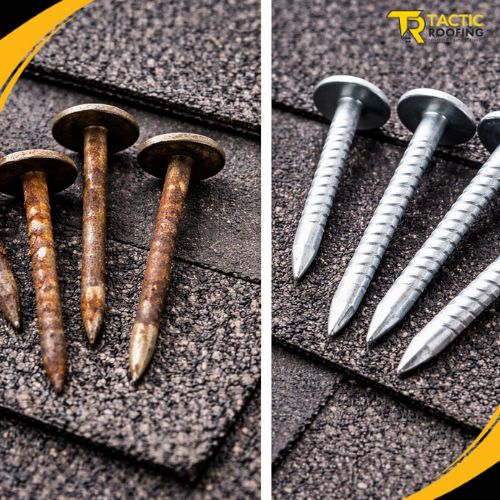
Hot-dipped galvanized roofing nails
-
Thicker protective zinc layer
-
Rougher surface improves grip
-
Greater resistance to corrosion
-
Preferred in harsh climates
Stainless steel nails
-
Exceptional corrosion resistance
-
Ideal for coastal or extreme environments
-
Higher material cost
The difference between a proper galvanized roofing nails specification and a cheap alternative may only be a few dollars per roofing square—but that difference can mean years of added performance.
The International Code Council building standards specify corrosion-resistant fasteners in areas subject to moisture exposure for this exact reason.
Nail Pull-Through: When Fasteners Fail From Above
Even corrosion-resistant nails can fail if improperly selected or installed.
Nail pull-through occurs when:
-
The nail head is too small
-
The shingle is overdriven
-
The decking is too thin
-
Wind uplift exceeds holding power
When pull-through happens, shingles detach while nails remain embedded in the deck.
This issue becomes especially serious in high-wind regions, a factor discussed in Best Roofing Materials for Homes in High-Wind Areas. Wind resistance depends as much on fasteners as on shingle design.
Ring Shank Nails: Added Grip Where It Matters
Standard smooth-shank nails rely primarily on friction. Ring shank nails feature ridges along the shaft, increasing withdrawal resistance significantly.
Advantages include:
-
Greater resistance to pull-out
-
Improved performance in softer decking
-
Better wind uplift resistance
In high-wind or cold climates, ring shank nails can meaningfully extend roof life by maintaining holding strength under stress.
Nail Length and Roof Decking: Why It’s Not Arbitrary
Correct nail length roof decking selection is crucial.
Building codes typically require that nails:
-
Penetrate through the roof decking
-
Extend at least ¾ inch into solid wood
-
Fully engage the structural substrate
Using nails that are too short:
-
Reduces holding power
-
Increases blow-off risk
-
Leads to premature loosening
Using nails that are too long:
-
Can split decking
-
Cause interior protrusions
-
Increase corrosion exposure in attic spaces
Fastener length must match deck thickness—especially when multiple shingle layers or roof re-cover projects are involved.
Fastener Failure in Cold Canadian Climates
In cold climates, thermal cycling intensifies fastener stress.
Metal expands and contracts at a different rate than wood decking. Over time, this movement can:
-
Loosen nails
-
Create micro-gaps
-
Increase moisture intrusion
This directly impacts Understanding Roofing Material Lifespan, because fastener performance is inseparable from material longevity.
Corrosion accelerates when freeze–thaw cycles trap moisture around nail shafts. That’s why high-quality galvanized or stainless fasteners are critical in cold regions.
How Cheap Nails Ruin Premium Shingles
Imagine investing in top-tier architectural shingles designed to last 30+ years—then securing them with low-grade nails.
Cheap nails may:
-
Corrode within 5–10 years
-
Snap under wind stress
-
Void manufacturer warranties
-
Lead to uneven shingle uplift
The cost difference between premium and low-quality nails on a full roof is minimal compared to the overall project. Yet the performance difference is enormous.
In roofing, saving money on fasteners is often the most expensive shortcut.
Overdriven vs Underdriven Nails: Installation Matters
Even perfect nails fail if driven incorrectly.
Overdriven nails
-
Head sinks too deep
-
Cuts into shingle surface
-
Reduces holding area
Underdriven nails
-
Sit proud of surface
-
Prevent shingles from sealing
-
Create uplift points
Proper air pressure calibration on nail guns and experienced installers make the difference.
Signs of Fastener Failure Homeowners Can Spot
Without removing shingles, you may notice:
-
Shingles lifting at corners
-
Rust staining near shingle tabs
-
Loose shingles after moderate wind
-
Persistent leaks without visible shingle damage
These often indicate underlying nail problems rather than shingle defects.
How Fastener Selection Impacts Wind Resistance
Wind uplift resistance depends on:
-
Nail head diameter
-
Shaft type (smooth vs ring shank)
-
Corrosion resistance
-
Correct placement within the nail strip
Fastener spacing also matters. High-wind installations often require six nails per shingle instead of four.
This detail can double uplift resistance in some systems.
The Relationship Between Nails and Warranty
Most major shingle manufacturers require:
-
Corrosion-resistant fasteners
-
Specific nail head diameters
-
Approved nail placement zones
-
Minimum deck penetration depth
Ignoring these requirements can void coverage—even if shingles themselves are high quality.
The Bottom Line: The Nail Is the Weakest Link—or the Strongest
Roofs fail at their weakest point. When nails corrode, pull through, or loosen, the entire roofing system becomes vulnerable.
Addressing roofing nails corrosion, choosing appropriate galvanized roofing nails, selecting correct nail length roof decking, and understanding how ring shank nails enhance grip are not technical trivia—they are central to roof longevity.
Shingles protect against weather. Nails protect against gravity and wind.
Choose wisely.
Fasteners Face a Harder Test North of the GTA
The freeze-thaw swings around Orangeville are wider than on the lakeshore, and every cycle makes the roof deck expand and contract under each nail. A fastener that is underdriven, overdriven, or misplaced gives up years sooner in that environment — popped nails and lifted shingle courses are the visible result. As a GAF factory-certified contractor, Tactic Roofing installs to manufacturer nailing specifications across Orangeville, Caledon, and the GTA. If your Orangeville roof is showing popped nails or lifted shingles, a free repair assessment will tell you how deep the problem goes.
Final Perspective: Big Performance, Small Component
In roofing, the smallest component can have the biggest impact. Fasteners don’t get attention because they’re hidden—but their failure is dramatic.
Cheap nails can shorten roof life by years. Correct fasteners can add decades.
The next time you evaluate a roofing project, ask about the nails. Because performance starts with what holds everything together.