


Few parts of a roof work harder than its valleys.
A roof valley is where two roof planes meet and channel water downslope. During heavy rain, snowmelt, or ice buildup, valleys carry more water per square inch than almost any other area of the roof. That concentration makes them a high-stress zone, and it’s why so many leaks trace back to poor valley design or workmanship.
Homeowners are often unaware that there are multiple roof valley types, each with different performance characteristics. The debate around open vs closed roof valley systems isn’t cosmetic—it directly affects durability, maintenance needs, and how long a roof lasts, especially in cold Canadian climates.
This article goes deep into how roof valleys work, how open and closed systems differ, why valleys fail, and which design tends to last longer when installed correctly.
Why Roof Valleys Matter So Much
Water doesn’t distribute evenly across a roof. It accelerates as it moves downslope and converges in valleys. During storms, valleys must handle:
- High-volume water flow
- Wind-driven rain pushed sideways
- Snow accumulation and melt cycles
- Ice refreezing at transitions
- Debris concentration (leaves, granules, needles)
Because of this, valleys experience:
- Faster material wear
- Greater thermal movement
- Higher risk of fastener exposure
- More stress on underlayment and flashing
As discussed in What Causes Roof Leaks and How to Prevent Them, leaks often originate where water slows, pools, or changes direction. Valleys check all three boxes.
The Two Main Roof Valley Types
While there are variations, most residential roofs use one of two valley designs:
- Open roof valleys
- Closed roof valleys
A third method—woven valleys—exists but is less common today and comes with specific limitations.
What Is an Open Roof Valley?
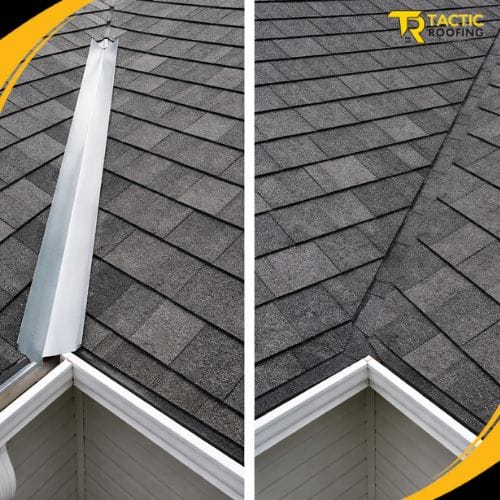
An open valley leaves a visible metal channel running down the center of the valley. Shingles stop short of the centerline, exposing a metal valley liner that carries water safely off the roof.
Key characteristics
- Metal (steel, aluminum, or copper) visible
- Shingles trimmed back from the center
- Dedicated water channel
- Typically paired with ice & water protection underneath
Advantages of open valleys
- Excellent water-shedding capacity
- Less debris trapping
- Faster drying after rain or snowmelt
- Easy visual inspection for damage or buildup
Open valleys excel in managing volume. Water has a clear, unobstructed path downhill.
What Is a Closed Roof Valley?
In a closed valley, shingles cover the valley completely. There is still a valley liner underneath, but it’s hidden beneath overlapping shingles.
Two common closed styles exist:
- Cut valley: shingles from one roof plane are cut along the valley line
- Woven valley shingles: shingles from both planes are interwoven
Advantages of closed valleys
- Seamless, uniform appearance
- No exposed metal
- Lower upfront material cost
However, appearance comes with trade-offs.
Woven Valley Shingles: Where They Fit (and Where They Don’t)
Woven valleys involve alternating shingle courses from each roof plane across the valley.
They can work on:
- Lower-slope roofs
- Asphalt shingles with sufficient flexibility
But woven valleys are vulnerable in colder climates. As shingles stiffen in winter, woven layers can crack, lift, or trap debris—shortening lifespan.
Why Valleys Fail Prematurely
Valley failures are rarely caused by one factor. They’re the result of stress stacking.
1. Water concentration
Valleys handle more runoff than any other shingle area. Minor defects become major entry points.
2. Ice and freeze–thaw cycles
In cold regions, valleys often freeze first and thaw last. Repeated expansion stresses seams and fasteners.
3. Debris buildup
Leaves and granules slow water and hold moisture against materials.
4. Poor detailing
Incorrect cuts, exposed nails, or improper underlayment laps undermine even the best materials.
According to National Roofing Contractors Association, valleys are among the most leak-prone roof areas specifically because of these combined stresses.
Open vs Closed Roof Valley: Durability Comparison
Water handling
- Open valley: superior water flow and drainage
- Closed valley: adequate when perfectly installed, but less forgiving
Debris resistance
- Open valley: debris washes out more easily
- Closed valley: debris can lodge under shingle edges
Ice performance
- Open valley: metal surface sheds ice more predictably
- Closed valley: shingles may trap ice and snow
Maintenance and inspection
- Open valley: issues are visible and easier to address
- Closed valley: problems remain hidden until damage occurs
Aesthetic preference
- Open valley: visible metal line
- Closed valley: uniform shingle appearance
Which Valley Type Lasts Longer?
When properly installed, open valleys generally last longer, especially in regions with:
- Heavy snow
- Freeze–thaw cycles
- Frequent rain events
This aligns with findings from Building Science Corporation, which emphasizes that roof assemblies perform best when water is shed quickly and allowed to dry.
Closed valleys can still perform well—but they are far more sensitive to workmanship quality. Small installation errors shorten their lifespan significantly.
The Role of the Valley Liner (Hidden but Critical)
Regardless of valley style, the valley liner is non-negotiable.
A quality valley liner includes:
- Ice & water membrane extending beyond the valley center
- Proper overlap with roof underlayment
- No fasteners in the center channel
- Clean, wrinkle-free installation
The liner is the last line of defense. Shingles are the first.
Common Installation Errors That Shorten Valley Life
- Exposed nails near the valley center
- Shingles cut too tight, blocking water flow
- Shingles cut too loose, allowing wind lift
- Skipping ice & water membrane in cold climates
- Misaligned cuts that funnel water sideways
These errors often lead to early failure—sometimes within a few years.
Valley Design and Roofing Material Lifespan
Valley choice directly affects how long roofing materials last, a topic explored in Roofing Material Lifespan in Cold Canadian Climates.
In cold regions:
- Open valleys reduce moisture retention
- Closed valleys increase reliance on shingle flexibility
As shingles age and stiffen, closed valleys become more vulnerable.
How Homeowners Can Spot Valley Problems
You don’t need to climb onto the roof to see warning signs.
Look for:
- Heavy granule accumulation at valley bottoms
- Uneven shingle edges along valleys
- Repeated leaks after storms or snowmelt
- Moss or dark staining along valley lines
These symptoms often point to valley stress—not general roof failure.
Choosing the Right Valley Type for Your Roof
An experienced roofer considers:
- Roof pitch and geometry
- Climate exposure
- Shingle type
- Aesthetic goals
- Long-term maintenance expectations
There is no universal “best” option—but there is a best option for your roof.
Final Perspective: Valleys Decide the Roof’s Fate
A roof rarely fails in the middle of a shingle field. It fails where water concentrates and stress compounds.
The open vs closed roof valley decision is one of the most important design choices in residential roofing. Open valleys tend to offer longer service life and better performance under harsh conditions. Closed valleys can look cleaner—but demand flawless installation and vigilant maintenance.
In roofing, longevity isn’t about how materials look on day one. It’s about how they manage water on day ten thousand.