
When homeowners think about their roof, they usually picture shingles, metal panels, or tiles—the visible layers that protect the house from rain, snow, and sun. But one of the most critical components of any roofing system is completely hidden from view: the roof decking. Understanding plywood vs OSB roof decking is essential because this structural layer directly affects your roof’s strength, lifespan, and resistance to moisture-related failure.
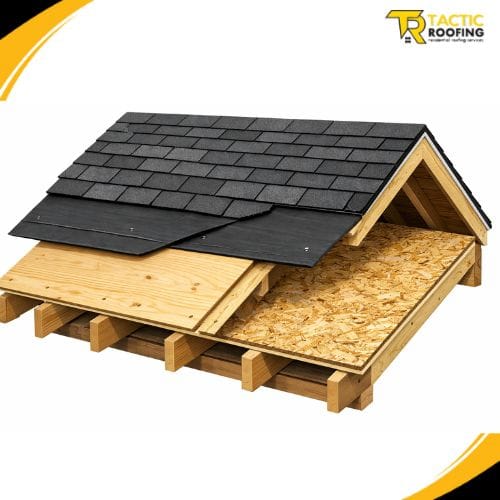
Roof decking (also called roof sheathing) is the solid surface attached to the rafters or trusses that supports everything above it. Shingles, underlayment, flashing, and ventilation systems all depend on the decking being flat, strong, and dry. When it’s compromised, even the best roofing materials cannot perform as intended.
This article explains what roof decking is, compares plywood and OSB in real-world conditions, outlines when replacement is necessary, and shows what a quality contractor evaluates before installing a new roof.
What Roof Decking Actually Does
Roof decking has three core jobs:
- Structural support
It distributes loads from shingles, snow, wind, and foot traffic evenly across rafters or trusses. - Attachment surface
Nails, fasteners, and adhesives rely on the decking for holding power. Weak decking means loose shingles. - Moisture buffer
While not waterproof, decking must tolerate occasional moisture without rapid deterioration.
Different roof sheathing types exist, but plywood and OSB (oriented strand board) dominate residential construction today.
Plywood vs OSB Roof Decking: Material Basics
Plywood Roof Decking
Plywood is made from thin layers of wood veneer glued together with alternating grain directions. This cross-layering gives plywood predictable strength and dimensional stability.
Key characteristics:
- Excellent nail-holding ability
- More forgiving when exposed to moisture
- Tends to dry out faster after getting wet
- Typically more expensive
OSB Roof Decking
OSB is manufactured from compressed wood strands bonded with resin and wax under high pressure. It’s engineered for consistency and efficient use of wood fibers.
Key characteristics:
- Uniform strength across panels
- Lower cost than plywood
- Widely used in modern construction
- More sensitive to prolonged moisture exposure
From a purely structural standpoint, modern OSB meets building code requirements in most regions. The real differences emerge under stress—especially moisture.
Roof Decking Strength: How They Compare in Practice
On paper, both materials can meet required roof decking strength ratings. In practice, performance diverges under less-than-ideal conditions.
- Plywood tends to retain integrity longer when repeatedly exposed to moisture. Even if it swells slightly, it usually returns close to its original shape after drying.
- OSB can swell at panel edges when wet and may not fully return to its original thickness. Repeated wetting can permanently weaken fastener grip.
This matters most in climates with:
- Heavy rainfall or snow
- Ice dams and freeze–thaw cycles
- High humidity or poor attic ventilation
As one building-science publication explains, “Engineered panels perform well when kept dry, but extended moisture exposure significantly reduces their structural reliability.” This is why decking condition is critical during reroofing.
Roof Deck Thickness: Why It’s Not One-Size-Fits-All
Roof deck thickness plays a major role in durability and stability. Common residential thicknesses include:
- 3/8 inch (older construction, now largely outdated)
- 7/16 inch (minimum code-compliant in many areas)
- 1/2 inch and thicker (preferred for long-term performance)
Thicker decking:
- Reduces deflection between rafters
- Improves nail-holding power
- Handles heavier roofing materials better
A quality contractor considers rafter spacing, local snow loads, and roofing type before approving decking thickness. Thinner panels may pass inspection but shorten the roof’s lifespan.
When Roof Decking Must Be Replaced
Decking does not always need full replacement during reroofing—but sometimes it absolutely does. Common indicators include:
- Soft or spongy areas underfoot
- Dark staining or visible mold growth
- Delamination in plywood layers
- Swollen or crumbling OSB edges
- Rusted or loose fasteners
Ignoring these signs often leads to hidden costs later. As one construction industry authority warns, “Covering damaged decking with new shingles is one of the most common causes of premature roof failure.”
This is where roof re-decking becomes necessary—not optional.
Roof Re-Decking: Cost vs Consequence
Many homeowners hesitate when a contractor recommends re-decking because it increases upfront cost. However, the alternative is often worse.
Failing to replace compromised decking can lead to:
- Shingles blowing off prematurely
- Recurrent leaks even after a “new roof”
- Structural deterioration of rafters or trusses
This directly ties into broader decisions like Roof Restoration vs Roof Replacement. Restoration strategies only work when the underlying structure—including decking—is sound. Otherwise, restoration becomes temporary concealment rather than a solution.
Similarly, The Cost of Neglecting Roof Maintenance often shows up first in the decking layer. Small leaks that go unnoticed slowly saturate the sheathing, turning a minor repair into a structural issue.
Moisture, Ventilation, and Decking Lifespan
Decking longevity depends heavily on attic conditions. Even high-quality plywood will fail prematurely if ventilation is poor.
Key factors include:
- Balanced intake and exhaust ventilation
- Proper insulation depth and coverage
- Sealed attic penetrations
Warm, moist air condensing on cold decking during winter is one of the most common hidden causes of sheathing decay. OSB is particularly vulnerable in these conditions.
According to a U.S. Department of Energy publication, “Inadequate attic ventilation increases moisture accumulation and accelerates roof material degradation.” Decking is often the first casualty.
What a Quality Roofing Contractor Checks Before Installing Shingles
A professional roofer does far more than “tear off and re-shingle.” Before installation, they evaluate:
- Decking integrity
Walking the roof to identify soft spots and deflection. - Fastener holding power
Checking whether nails withdraw easily—a sign of weakened decking. - Panel spacing and expansion gaps
Improper spacing leads to buckling when panels expand. - Moisture content
Wet decking should never be covered. Trapped moisture accelerates rot. - Compatibility with roofing system
Heavier materials demand stronger decking.
Skipping these checks often leads to warranty issues and shortened roof life.
Plywood vs OSB: Which Is Better for Your Home?
There is no universal answer. The right choice depends on:
- Climate conditions
- Budget constraints
- Roof design and pitch
- Ventilation quality
- Long-term ownership plans
Plywood is often preferred for:
- High-moisture or cold climates
- Homes with a history of ice dams or leaks
- Owners prioritizing maximum durability
OSB is commonly chosen for:
- Cost-sensitive projects
- New construction with proper ventilation
- Shorter-term ownership strategies
The key is not the material alone, but correct installation, thickness, and moisture management.
Final Thoughts: What’s Under Your Roof Truly Matters
The debate over plywood vs OSB roof decking isn’t academic—it’s structural. Decking determines how well your roof resists wind, moisture, and time itself. Shingles are replaceable; damaged decking often is not without major disruption.
A roof is only as strong as what supports it. Understanding roof sheathing types, choosing proper roof deck thickness, and addressing decking issues during reroofing are decisions that directly affect safety, cost, and longevity.
When homeowners focus only on what they can see, problems grow underneath. Smart roofing decisions start below the surface.