
Most homeowners hear “Class A” and assume it means a roof can’t burn. That’s not what these ratings mean—and misunderstanding them leads to bad decisions, false confidence, and missed opportunities to make your roof system safer.
In Ontario, “fire-resistant” roofing isn’t one product you buy and forget. It’s a performance target that depends on the roof covering, the underlayment beneath it, the roof deck, and (most overlooked) the way everything is detailed at edges, penetrations, and transitions. If you’re shopping for fire resistant roofing Ontario homeowners can rely on, the real question is: What exactly is being tested, and under what conditions?
What “Class Ratings” Are Measuring
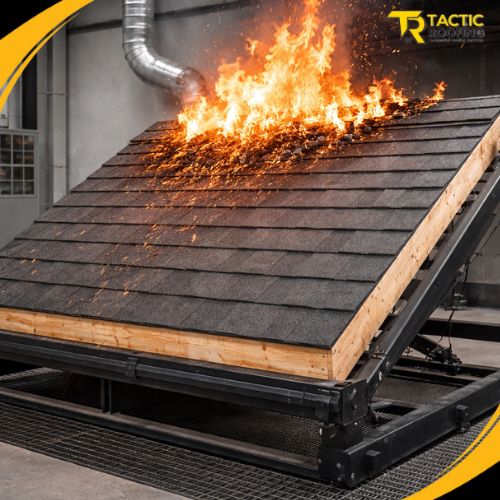
Fire ratings for roof coverings are meant to simulate fires that start outside the building—think wind-blown embers, nearby structure fires, or burning debris landing on the roof surface. In Canada, the most referenced pathway is CAN/ULC testing; as SOPREMA summarizes it, “CAN/ULC-S107 is the primary reference for evaluating the fire resistance of roof assemblies.” (Soprema) This matters because the rating is about the assembly (how components work together), not just the visible top layer.
Most North American class systems you’ll hear—Class A, B, and C—are built around the idea of increasing severity, including flame spread and burning “brand” exposure. A key takeaway: fire class ratings describe how a roof covering behaves under standardized external fire tests, not whether the entire home is “fireproof.”
Class A, B, C: The Simple Definitions (Without the Hype)
You’ll often see roof products marketed as “Class A roofing” without a clear explanation. Here’s the plain-language version:
- Class A roofing: highest performance under severe external fire exposure
- Class B: moderate performance
- Class C: light performance
Underwriters Laboratories puts it plainly in its overview of roof fire exposures: “Class A roof coverings, which are effective against severe fire test exposures.” That short line is doing a lot of work. It means Class A is comparative—it’s the best of the standard classes in the test environment. It does not mean the roof can’t ignite under every real-world scenario.
Why “Fire Rating Shingles” Are Not All the Same
Many homeowners assume shingles either have a rating or they don’t. In reality, fire rating shingles can differ by:
- Product design (fiberglass mat vs organic felt base, thickness, granule coverage)
- Tested assembly configuration (deck type, underlayment, fastening method)
- Listing conditions (certain underlayments required to achieve Class A)
That last point is where confusion explodes. Some roof coverings achieve Class A only when installed with specific underlayments or barrier layers. In other words, you can buy a “Class A” shingle—and still miss the rating in practice if the installer builds a different assembly than the listed one.
“By Product” vs “By Assembly”: The Hidden Detail That Changes Everything
If you want to understand fire-resistant roofs like a pro, learn this distinction:
- By product: the roof covering itself achieves the rating on common decks with standard underlayments.
- By assembly: the roof achieves the rating only when installed with specific supporting layers.
In Ontario, that “assembly thinking” matters because roofs aren’t built in lab conditions. Your deck might be plywood or OSB. Your underlayment might be synthetic. Your attic ventilation might change how heat and smoke move. A strong rating comes from a system that’s designed and installed to match the tested configuration.
What Actually Impacts Real-World Fire Resistance on a Roof
Class ratings are meaningful, but real fire behavior is messy. Several practical factors can raise or lower how a roof performs when it matters.
1) Vulnerable zones: edges, valleys, and penetrations
A roof rarely fails in the middle of a clean shingle field. Fire exposure (like embers) tends to exploit gaps and turbulence zones:
- valleys where debris collects
- behind chimneys where leaves and needles pile up
- around vents, skylights, and flashing transitions
This overlaps with lessons from “The Role of Roof Flashing in Leak Prevention” in a surprising way: the same detailing discipline that keeps water out also reduces entry points where embers can lodge.
2) Debris and maintenance
Even the best fire resistant roof materials perform worse when gutters are packed with dry leaves. In many real roof ignition events, the roof covering isn’t the first thing to catch—debris is. Keeping valleys and gutters clean is not “homeowner busywork”; it’s part of the roof’s fire performance.
3) Underlayment choice
Underlayment affects fire behavior and also influences whether your roof matches a tested assembly. This is one reason the selection process shouldn’t be a last-minute substitution. If a system requires a specific underlayment to meet a class rating, swapping it for a cheaper roll can quietly downgrade performance.
4) Roof geometry and exposure
Steeper roofs shed debris and snow differently than low-slope roofs. Certain designs create corners and eddies where embers can gather. Roof shape doesn’t change the label on the shingle bundle—but it changes the risk profile.
5) Installation quality
A fire class rating doesn’t compensate for poor workmanship. Exposed fasteners, sloppy flashing, misaligned ridge caps, and shortcuts at penetrations all create weak points. That’s why “Roof Repair Mistakes You Should Avoid” isn’t just about leaks; bad details can also create fire vulnerabilities.
Which Materials Typically Reach Higher Classes
Homeowners often ask, “What’s the most fire-resistant roof?” The more useful question is, “What material and assembly reliably reach Class A—and fit my home’s goals?”
Asphalt fiberglass shingles (very common in Ontario)
Most modern fiberglass-based asphalt shingles can achieve Class A in many configurations. They’re popular because they balance cost, performance, and availability. If you’re shopping in the GTA, this is often the baseline option for fire resistant roofing Ontario upgrades—especially when paired with correct underlayment and edge detailing.
Metal roofing
Metal itself is noncombustible, but ratings still depend on the full assembly (deck and underlayment). Metal can be an excellent choice when you want durability and a strong fire profile, but it must be installed correctly—especially around penetrations and at the ridge.
Slate, clay, and concrete tile
These are naturally noncombustible and often associated with high fire performance. They’re also heavier, which can require structural evaluation, and they come with higher installed cost. For some Ontario homes, that tradeoff is worth it; for others, it’s not practical.
Synthetic composites
Many composite shingles and tiles are engineered for Class A performance, but results vary widely by product and listing. This category is where you should be extra strict about documentation and assembly requirements.
Wood shakes/shingles (high caution)
Untreated wood is typically a poor fire performer. Fire-retardant-treated systems exist, but they demand ongoing maintenance and careful verification. For most homeowners prioritizing fire resistance, wood is usually not the first recommendation.
How to Read a Roofing Fire Rating Like a Homeowner (Not an Engineer)
When you’re reviewing proposals or comparing products, use this quick checklist:
- Ask what class rating is being offered (A, B, or C).
- Ask whether the rating is “by assembly.” If yes, request the required layers.
- Confirm the underlayment and deck assumptions.
- Ask how valleys, chimneys, and penetrations will be detailed.
- Request product documentation that matches what will actually be installed.
If you want the process to be simple, start with a contractor who treats specs seriously. The mindset behind “Roofing Company Canada Services You Can Count On” is exactly this: no substitutions that quietly change system performance.
Picking the Right Fire-Resistant Roof in Ontario Based on Your Goals
Different homeowners prioritize different outcomes. Here’s a practical way to choose:
- You want strong fire performance at a reasonable cost: Class A asphalt fiberglass shingles with documented assembly details.
- You want a long-life roof with strong resistance and less maintenance: Consider metal with correct underlayment and excellent detailing.
- You’re balancing multiple hazards (fire + storms): Use fire rating as one pillar, but also compare impact resistance—see “Best Roofing Materials for Hail-Prone Areas in Canada” as a complementary decision guide.
- You’re optimizing for longevity overall: Fire performance should sit alongside ventilation, insulation, and maintenance planning—core themes in “Understanding Roofing Material Lifespan.”
The Bottom Line: Ratings Matter, But Assemblies Matter More
Class ratings are useful when you know what they represent: standardized external fire performance. In Ontario, the best outcomes come from selecting Class-appropriate materials and building the roof assembly to match the listing—then executing the details correctly at the very places roofs usually fail first.
If you remember one thing: the label on the shingle bundle is only the start. The roof you actually get depends on the system underneath and the workmanship holding it together.