
If you’ve ever dealt with recurring leaks behind a chimney, you’ve likely been chasing symptoms—not the cause. Homeowners often replace flashing, reseal joints, or patch shingles, only to see the same stains return after the next heavy rain or thaw. The missing piece is frequently an upgrade many people don’t even know exists: chimney cricket installation.
A chimney cricket (also called a chimney saddle) is a small, peaked structure built on the uphill side of a chimney. Its job is simple but powerful—split and redirect water around the chimney so it can’t pool, back up, or force its way under shingles and flashing. In climates with snow, ice, and wind-driven rain, this single detail can dramatically reduce chronic moisture problems.
This article explains what a chimney cricket does, which roof and chimney shapes need one, how it works with flashing systems, and why it’s one of the most effective yet overlooked upgrades in residential roofing—especially in local conditions where freeze–thaw cycles are common.
Why Chimneys Are a Persistent Leak Point
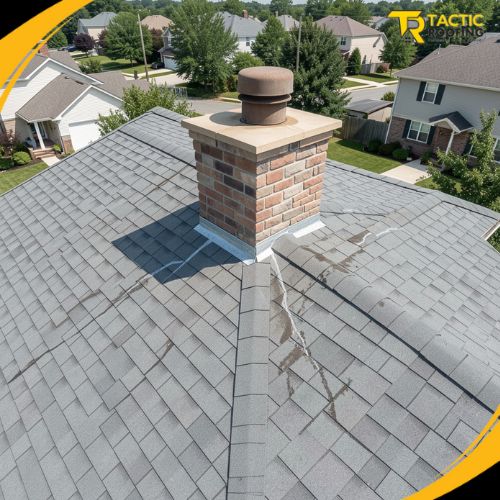
Chimneys interrupt the roof plane, creating turbulence in water flow. Instead of running smoothly downslope, rain and melting snow slam into a vertical masonry wall and slow down. That slowdown causes:
- Water pooling behind the chimney
- Debris accumulation (leaves, needles, ice)
- Ice buildup in winter
- Increased pressure on flashing seams
Even a perfectly installed flashing system can struggle when water is constantly trapped against it. Over time, sealants fail, metal fatigues, and moisture finds a path inside.
This is why many leaks traced to chimneys aren’t actually “flashing failures” in isolation—they’re water management failures.
What a Chimney Cricket Actually Does
A chimney cricket is a small, roof-like structure built behind the chimney on the uphill side. It creates two sloped planes that divide water and guide it around the chimney instead of letting it collect.
Its core functions include:
- Chimney water diversion away from the back wall
- Reducing standing water and ice accumulation
- Lowering stress on step flashing and counterflashing
- Improving long-term roof and masonry performance
Think of it as a traffic director for water. Instead of forcing everything to stop and pile up behind the chimney, the cricket keeps water moving.
Chimney Cricket vs. Flashing: Not the Same Thing
Flashing seals joints. A cricket manages water volume.
This distinction is critical. Flashing is designed to handle runoff that passes by a joint—not water that sits there for hours or days. When water ponds behind a chimney, it increases hydrostatic pressure and exploits the smallest imperfections.
As the National Roofing Contractors Association explains, “Effective roof design focuses on shedding water as quickly as possible; relying on sealants alone is not a durable strategy.” A chimney cricket embodies that principle by preventing water from lingering where it does the most damage.
Which Roof and Chimney Shapes Need a Cricket?
Not every chimney requires a cricket—but many should have one and don’t.
Chimney width matters most
As a general rule, chimneys wider than about 30 inches (measured perpendicular to the roof slope) benefit significantly from a cricket. Wider chimneys create larger dead zones where water slows and pools.
Roof pitch increases risk
Low- to moderate-slope roofs are more vulnerable because water moves more slowly. On steeper roofs, water sheds faster, but wide chimneys can still create turbulence and ice dams.
Masonry chimneys are prime candidates
A masonry chimney roofing detail introduces porous materials, mortar joints, and thermal mass. Masonry stays colder in winter, encouraging ice formation behind the chimney—exactly where crickets are most effective.
Local climate plays a role
In regions with:
- Heavy snowfall
- Freeze–thaw cycles
- Wind-driven rain
Chimney crickets are not just helpful—they’re preventative.
Why Chronic Leaks Happen Behind Chimneys
If a chimney leaks repeatedly despite repairs, the pattern is usually the same:
- Water collects behind the chimney
- Ice or debris traps moisture
- Flashing handles more water than it was designed for
- Sealants fatigue and crack
- Moisture enters the roof assembly
Homeowners often address step 4 without solving steps 1–3. A chimney cricket tackles the problem at its source.
The Building Science Corporation notes that “most enclosure failures occur not from material defects, but from poor control of water flow.” Chimney crickets are a textbook example of improving control rather than chasing leaks.
How a Chimney Cricket Is Built
A properly constructed chimney cricket includes:
- A framed, sloped structure tied into the roof deck
- Sheathing and underlayment integrated with the main roof
- Metal flashing and counterflashing at the chimney
- Shingle or metal covering that matches the roof system
The slope of the cricket is calculated to match or slightly exceed the main roof pitch so water doesn’t slow down as it crosses.
This is not a cosmetic add-on—it’s a structural roofing detail.
Common Installation Mistakes to Avoid
Like many upgrades, chimney crickets only work when installed correctly.
Mistake 1: Making it too shallow
A cricket with insufficient slope won’t divert water effectively and can still allow pooling.
Mistake 2: Poor flashing integration
The cricket must work seamlessly with step flashing and counterflashing. Gaps or reverse laps defeat the purpose.
Mistake 3: Relying on sealant instead of geometry
Caulking should be supplemental, not primary. The shape of the cricket should do most of the work.
Mistake 4: Skipping underlayment continuity
Underlayment must run continuously from the roof onto the cricket and back again to prevent hidden leaks.
Chimney Crickets and Roof Longevity
Installing a chimney cricket doesn’t just stop leaks—it extends the life of multiple systems:
- Roofing materials last longer without constant moisture exposure
- Flashing experiences less stress and movement
- Masonry stays drier, reducing mortar deterioration
- Ice dam risk behind chimneys drops significantly
This aligns directly with the principles discussed in The Role of Roof Flashing in Leak Prevention: flashing performs best when water is moving, not pooling.
New Roof vs. Retrofit: When to Add a Cricket
During roof replacement
This is the ideal time. Access is easy, integration is clean, and cost is minimal compared to future repairs.
On an existing roof
Retrofit installation is possible and often recommended when:
- Recurrent chimney leaks occur
- Flashing has been repaired multiple times
- Ice buildup consistently forms behind the chimney
While retrofits cost more than new-install installs, they often pay for themselves by eliminating repeated repairs.
Chimney Crickets and Other Roof Penetrations
Chimneys aren’t the only penetrations that benefit from smart water diversion. Similar principles apply to skylights and dormers, which is why Skylight Installation and Roof Integrity emphasizes slope, drainage, and flashing integration.
The broader lesson: roofs fail where water slows down. Chimney crickets are one of the clearest examples of solving that problem with design—not sealant.
What Homeowners Should Look For
You don’t need to be a roofer to recognize whether a cricket is present or needed.
Look for:
- A peaked structure behind the chimney on the uphill side
- Signs of debris or ice buildup in that area
- Repeated staining near chimney walls inside the home
- Flashing repairs that haven’t solved leaks
If your chimney is wide and the roof behind it is flat or gently sloped, the absence of a cricket is a red flag.
Why Most Homeowners Don’t Know About Chimney Crickets
Chimney crickets aren’t visible from the ground, aren’t discussed in most sales pitches, and aren’t required on every roof. As a result, they’re rarely explained—despite their impact.
But roofing is about managing water intelligently. And in that context, chimney crickets are one of the smartest upgrades available.
Final Perspective: A Small Structure With Outsized Impact
A chimney cricket doesn’t make your roof look better. It makes it work better.
By redirecting water away from one of the roof’s most vulnerable areas, chimney cricket installation reduces chronic leaks, protects flashing, and improves long-term durability—especially in climates where snow and ice are part of life.
For homeowners tired of fixing the same leak over and over, a chimney cricket isn’t an upgrade—it’s the missing solution.