
When homeowners in the Greater Toronto Area think about roofing upgrades, most of the attention goes to shingles or metal panels. Yet one of the most important performance layers sits completely out of sight. The debate over synthetic vs felt underlayment isn’t about minor details—it’s about how well your roof handles moisture, temperature swings, and installation stress over decades.
Roof underlayment is the layer installed directly on the roof deck, beneath shingles or metal panels. It acts as a secondary water barrier, protects the deck during installation, and plays a key role in how the entire roofing system ages. In a climate like the GTA—where roofs experience heat, cold, rain, snow, and freeze–thaw cycles—choosing the right underlayment matters far more than many homeowners realize.
This article offers a practical, experience-based roofing underlayment comparison, explains how synthetic and felt perform under Canadian conditions, and helps you decide what makes sense based on roof pitch, material choice, and long-term goals.
What Roof Underlayment Actually Does
Before comparing materials, it’s important to understand what underlayment is responsible for:
- Acting as a backup water-shedding layer if shingles fail
- Protecting the roof deck from wind-driven rain and ice-related intrusion
- Allowing limited drying of the roof assembly
- Providing a safe, walkable surface for installers
Underlayment is not designed to replace shingles, but when properly selected, it significantly reduces the risk of leaks and deck damage—especially during extreme weather or delayed repairs.
Traditional Felt Underlayment: The Old Standard
Felt underlayment (often called asphalt-saturated felt or tar paper) has been used for decades across North America.
What it’s made of
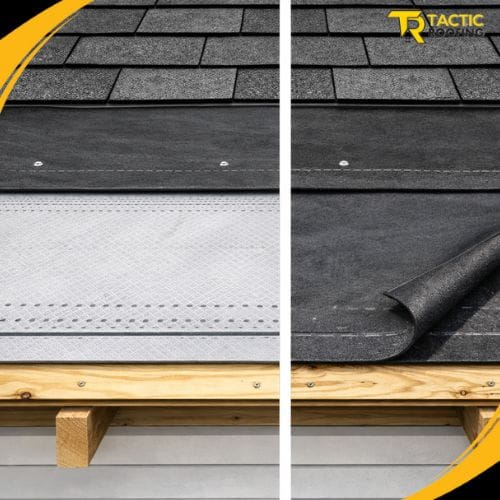
Felt is typically produced from cellulose or fiberglass mats saturated with asphalt. Common weights include 15 lb and 30 lb felt, with heavier versions offering more durability.
Advantages of felt underlayment
- Lower upfront material cost
- Long track record and wide familiarity
- Decent performance on steep-slope roofs
- Good compatibility with asphalt shingles
Limitations in GTA conditions
- Absorbs moisture and wrinkles when wet
- Tears easily under foot traffic
- Becomes brittle in cold temperatures
- Degrades faster when exposed to UV
In the GTA, roofs often sit exposed during installation or repairs. Felt’s tendency to absorb moisture and wrinkle can compromise shingle alignment and long-term performance.
Synthetic Underlayment: Engineered for Performance
Synthetic underlayments are made from woven or spun polymers, designed specifically for modern roofing systems.
Key characteristics
- Lightweight and dimensionally stable
- Highly tear-resistant underlayment
- Often rated for extended UV exposure
- Designed to remain flexible in cold weather
Advantages of synthetic underlayment
- Does not absorb water or wrinkle
- Maintains strength in freezing conditions
- Easier and safer for installers to walk on
- More consistent performance across roof pitches
According to the National Roofing Contractors Association,
“Synthetic underlayments generally offer improved tear resistance, UV stability, and walkability compared to traditional felt,”
highlighting why many professionals now prefer them for residential projects.
Performance in Heat and Cold: Why Climate Matters
Cold-weather performance (a major GTA concern)
In winter conditions, felt can become stiff and prone to cracking, especially during installation or repairs. Synthetic products, by contrast, remain flexible and maintain fastener integrity in sub-zero temperatures.
This flexibility reduces the risk of:
- Fastener pull-through
- Micro-tears during installation
- Cracking when the deck shifts
In cold Canadian climates, this difference directly impacts roof longevity, as discussed in Roofing Materials Lifespan in Cold Canadian Climates.
Heat and UV exposure
During summer or extended installations:
- Felt dries out and becomes brittle when exposed to heat
- Synthetic underlayment often carries longer UV exposure ratings
This is especially important when projects are delayed by weather or scheduling.
Breathability and Moisture Management
A common misconception is that all underlayments trap moisture. In reality, some synthetic products are engineered as breathable underlayment, allowing water vapor to escape while still blocking liquid water.
Why this matters:
- Reduces condensation risk in attic spaces
- Helps roof decks dry after minor moisture events
- Improves overall roof assembly health
Felt offers limited breathability but loses effectiveness when saturated. Synthetic breathable membranes are more predictable and stable in mixed humidity conditions common in the GTA.
Slip Resistance: Safety for Installers (and Quality for Homeowners)
Roofing safety directly affects installation quality. A roofer who feels secure moves more deliberately and installs materials more accurately.
Synthetic underlayment often includes:
- Textured surfaces
- Printed traction patterns
- Higher friction coefficients when wet
Felt, especially when damp, can become slippery and tear under foot pressure.
OSHA roofing safety guidance emphasizes that stable walking surfaces reduce fall risk and improve installation consistency. This is one reason many contractors prefer synthetic materials, even when homeowners never see them.
Synthetic vs Felt Underlayment on Different Roof Pitches
Low-slope and complex roofs
Synthetic underlayment performs better on:
- Low-pitch roofs
- Roofs with valleys and dormers
- Areas prone to wind-driven rain
Its dimensional stability helps maintain coverage without shifting or bunching.
Steep-slope roofs
Felt can still perform adequately on steep slopes with:
- Quick installation
- Favorable weather
- Simple roof geometry
However, synthetic underlayment still offers better durability during installation.
Compatibility with Roofing Materials
Your choice of underlayment should align with your roof covering.
Asphalt shingles
Both felt and synthetic are compatible, but synthetic offers:
- Better long-term durability
- Improved nail-holding consistency
This aligns well with considerations discussed in Asphalt vs Metal Roofs, where underlayment choice affects overall system performance.
Metal roofing
Synthetic underlayment is generally preferred under metal roofs because:
- It resists high temperatures
- It reduces noise and friction
- It maintains integrity under expansion and contraction
Felt under metal roofs can degrade faster due to heat buildup.
Cost vs Value: Looking Beyond the Price Tag
At first glance:
- Felt is cheaper per roll
- Synthetic costs more upfront
But cost should be evaluated over the roof’s lifespan.
Synthetic underlayment can:
- Reduce installation time
- Lower risk of callbacks
- Extend roof service life
As the Insurance Institute for Business & Home Safety has noted, secondary moisture barriers play a critical role in limiting damage during extreme weather events—something increasingly relevant in Ontario.
When considering the full system cost, synthetic underlayment often delivers better value.
When Felt Underlayment Still Makes Sense
Felt may still be appropriate when:
- Budget constraints are strict
- The roof is steep and simple
- Installation will be completed quickly
- Climate exposure is minimal during work
However, these conditions are becoming less common in real-world GTA projects.
Making the Right Choice for Your Project Goals
Choose synthetic underlayment if your priorities include:
- Long-term durability
- Cold-weather performance
- Enhanced installer safety
- Compatibility with metal or premium roofing
Choose felt underlayment if:
- Cost is the primary driver
- The roof design is simple
- Installation timing is tightly controlled
There is no single “best” option—only the best fit for your roof, climate, and expectations.
Final Thoughts: Performance You’ll Never See—but Always Rely On
The decision between synthetic vs felt underlayment is one of the most overlooked yet impactful choices in roofing. In the GTA’s demanding climate, underlayment isn’t just a code requirement—it’s a performance layer that quietly determines how well your roof resists moisture, temperature stress, and time itself.
Homeowners may never see it, but when storms hit or winters drag on, the right underlayment choice makes the difference between a roof that lasts and one that fails early.